Meta Museum
Source-backed museum data, gated to production by evidence.
A public-facing Linked Art web app that turns 14 museum collection APIs into source-backed exploration, rights-aware review, and governed publication. JSON-LD is canonical end to end, AI agents draft cited, rights-checked notes while humans approve before anything ships. Built on Next.js 16 and React 19, AIDD + TDD-driven, with a strict 10/10 readiness gate that stays closed until real-world reliability evidence matures. The product now splits in two: a plain-language public museum for visitors, and a professional workspace for researchers and partner organizations.
A museum-data product with a trust model, not just a search UI
Collection records are only valuable when researchers can inspect provenance, rights, citations, and transformation history. Meta Museum bets on Linked Art JSON-LD as the canonical model, then exposes it through web pages, APIs, agent-assisted review, and governed publication paths.
Most aggregators flatten provider quirks into a lowest-common-denominator search box. Meta Museum keeps each source faithful: fourteen museums sit behind one gateway, each isolated in its own adapter, with raw payloads preserved and provenance carried on every record-touching path. Public pages and APIs share the same source-backed evidence instead of detached marketing copy, and every image surface shows rights, reuse status, and attribution, with unknown rights rendered as an explicit non-reuse warning.
Layered Next.js product over an adapter boundary
A TypeScript App Router front of house, a faithful provider-integration layer, and Python services for validation and reconciliation, joined by a canonical Linked Art model that maps to UI shapes only at the boundary.
Next.js 16 App Router
React 19 pages and 175 app/api route handlers serve public explore surfaces, records, docs, trust pages, and Linked Art endpoints, with Zod contracts as leaf modules and content negotiation for application/ld+json. The production build compiles 216 routes.
Per-provider adapters
Met, Getty, Rijksmuseum, NGA, RKD, Louvre, Harvard, Smithsonian, V&A, Princeton, Europeana, AIC, CMA, and Museums Victoria each get an isolated adapter behind a stable /api/providers/* facade, cross-provider logic lives in one artwork-builder boundary, and public counts derive from the capability registry rather than copied constants.
Linked Art JSON-LD
Event-centric CIDOC-CRM modeling (Object → Activity → Person), minted URIs with no blank nodes, multi-value properties kept as arrays, and immutable _source.raw payloads transformed only at read time.
Real production stack
Next.js on Vercel, managed documents in Neon Postgres (JSONB), Python FastAPI validation and reconciliation services on Render, and secured cron drains for background projection and publishing. Solr 9 and GraphDB provide the search and graph scale path.
Bounded surfaces, adapters, and review services
The product is a set of clearly-owned surfaces: integration boundaries, a canonical normalizer, a human-in-the-loop AI layer, and syndication.
Provider gateway
Fourteen governed collection adapters plus a MoMA snapshot adapter and a capability registry isolate upstream API differences behind one stable facade.
Linked Art normalizer
Keeps JSON-LD canonical, rights entities, identifiers, equivalent links, activities, and immutable source payloads preserved.
AI query & agents
Claude-backed query, chat, content generation, and review agents with cite-or-refuse gates. The paid path is auth-gated, so anonymous traffic falls back to local heuristics.
Rights-first UX
Every card and detail page surfaces source URL, attribution, and a reuse-status badge, and unknown rights flag "Rights, review".
ActivityStreams feed
An Activity Streams 2.0 change feed publishes ordered Create, Update, and Delete pages, harvested by two named clients. The project scores its own outside adoption at 0 of 3.
IIIF & reconciliation
OpenSeadragon deep zoom plus exhibition and literature reconciliation, with multi-tenant orgs and RBAC.
Public discovery
A plain-language visitor track: a provider-balanced homepage rotation, Surprise me, a UTC-dated Artwork of the Day, and public-first artwork pages.
Connections
Artwork-led chaptered journeys that walk source-backed steps to a bounded reveal, keeping fact and inference labels and rejected-claim boundaries visible.
Evidence ledger
A public ledger and an editor-gated readiness page compact partner proof, dataset proof, SLO progress, and open blockers into one reviewable surface.
Agents draft, humans approve, nothing ships unreviewed
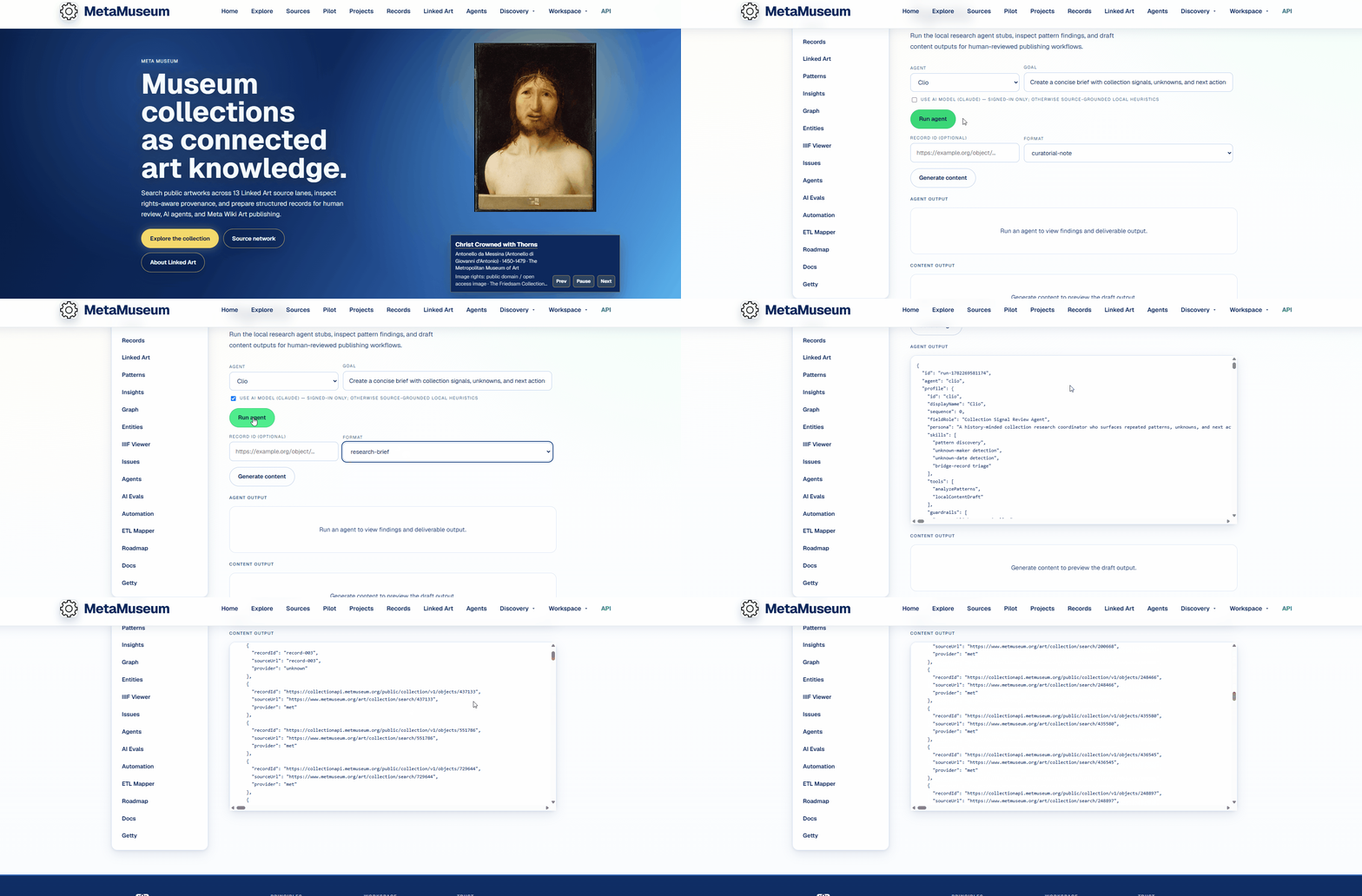
Janus reconciles across sources, Themis checks rights and provenance, Calliope drafts curatorial copy, Clio handles scoped research, and Mercator maps unfamiliar column shapes. Every one of them writes to a review queue with reviewer-facing diagnostics attached, and only a human promotes to production.
Standards-grade, tested first, secure by default
- Standards-grade Linked Art. JSON-LD is canonical end to end, and an executable conformance suite maps each provider's data to the Linked Art 1.0 reference model, SHACL-gated in CI so the JSON-LD expands to valid CIDOC-CRM RDF, verified against the live deploy at MUST level. A reusable graph partition planner splits arbitrarily shaped graphs into endpoint-family documents with compact cross-document references and recursion bounds.
- AIDD + TDD throughout. Every behavior is driven by a failing test first. 1,704 node:test tests run serially for shared-state determinism, strict TypeScript, 89.4% line coverage against a CI floor, and a 216-route production build gate.
- Accessibility measured, not assumed. The retained matrix covers 105 desktop, 200% reflow, and mobile route cases across 35 journeys, rejecting horizontal overflow as well as WCAG A/AA findings. That expanded pass is what exposed missing alt attributes on transient deep-zoom tiles, since fixed and regression-covered.
- Performance held to a budget. Canonical production evidence under Fast 4G and 4x CPU slowdown records 615 to 2,489 ms LCP, 0.00 CLS throughout, and 74 ms INP on the stressed mobile-menu interaction, with mobile Lighthouse at 100 for accessibility and SEO.
- AI shipped responsibly. The model key is server-only and the paid path is auth-gated, so anonymous traffic transparently falls back to local heuristics, a denial-of-wallet guard for a public deployment, with an eval harness of golden questions and faithfulness checks.
- Rights-first by default. Generated content must cite sources or refuse, agents draft while humans approve before any publication, and unknown-rights media renders an explicit non-reuse warning.
- Evidence-gated readiness. The strict 10/10 production claim cannot pass from local checks alone. It stays blocked until 30-day SLO, feed-adoption, invoice-backed pilot, retention, and margin evidence lands, and each contract rejects local substitutes by name. Readiness is a measured fact, not a marketing line.
- Honest about revenue. A live Stripe account, a restricted production key, and a nine-event webhook back a USD 29 research kit with published refund, privacy, and tax terms. Sandbox receipts are permanently excluded from revenue, and the commercial ledger still shows zero paid pilots because none have happened.
I wrote the rule that disqualifies my own evidence
Two systems harvest this feed in production. The project scores its outside adoption at zero out of three, and that is not an oversight.
The partner quickstart spells out what counts as strict adoption evidence: a stable partner-owned consumer id, the organization behind it, a public callback URL, a contact who can confirm what they observed, and a real reference such as a ticket or a log export. Then it names what does not count, and the list ends with MetaMuseum-owned IDs.
That clause disqualifies my own work. Both live consumers of this feed are other systems in this portfolio, so under the project’s own rule they earn exactly nothing toward the adoption number. The ledger reads 0/3 while two integrations run every day, and it will keep reading zero until somebody I do not control subscribes.
The rule points outward too. In August 2026 I opened a pull request against the Linked Art specification itself, a one-line clarification adding Getty’s existing ulan1102_student_of predicate to the unmodeled-relationship example. The predicate and its inverse direction were checked against the Getty Vocabulary Program ontology, the shape was tested here against the canonical context, and the upstream documentation site was built clean in a fresh environment before anything was submitted. It was raised in the Linked Art meeting channel first.
It is open for community review and has not been accepted. The contribution packet in this repository says so in as many words: submission is implementation evidence, not acceptance or community consensus. That sentence was written before there was any reason to soften it, which is the only time such a sentence is worth anything.
Two of the specification questions this project already implements against are still open, and the contribution there is implementation experience rather than proposed wording. On negative reconciliation the point worth making is that an automated no-link result is not a confirmed negative, and a property writable by any reconciliation pipeline will fill with "not yet matched" instead. On bounded response profiles it is that a brief record carrying a link to the full one avoids the circularity of having to fetch everything in order to ask for less.
The same instinct runs through the commercial side. Paid-pilot proof rejects invoice references that look like demo, fixture, placeholder, sample, smoke, or test data before they can satisfy anything, and sandbox Stripe receipts are permanently excluded from revenue. Every one of these gates exists to stop one specific person from believing a number he generated himself.
It is easy to write a metric you can pass. The useful skill is writing the one you currently fail, and then leaving it on the page where a buyer can read it.
Live, faithful, and honest about readiness
Meta Museum runs in production at metamuseum.org on Vercel, Neon, and Render. It showcases standards-grade Linked Art modeling, a fourteen-provider integration gateway, responsible AI with citation and rights gates, and evidence-driven release engineering. Every claim on the site is tied to a source or a passing check, including the claims the project makes about itself.